WEDGE 3 · INTERVENTIONAL ONCOLOGY

Precision / Interventional Oncology

Start by asking whether the case merits formal evaluation before discussing a technique, travel, or a specific procedure.

BKC coordinates evaluation through participating Fosun Health member hospitals in China. This page is not a diagnosis or treatment recommendation.

Understand the topic in more depth

Medical library →
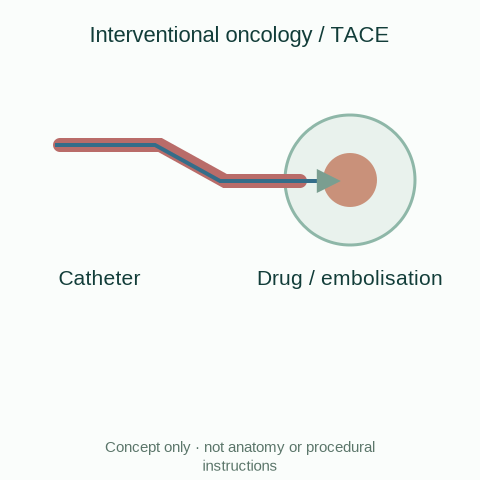
Principle diagram: Interventional oncology / TACE
Original BKC concept illustration; not a device photograph, anatomical image, or instructions for performing a procedure.
Principle & mechanism

Interventional oncology uses imaging to guide catheter or needle procedures. TACE delivers medicines and embolic material into tumour-supplying vessels in selected cases.

What informs suitability

Assessment considers vascular anatomy, tumour type and extent, organ function, clotting, and other therapies. Liver reserve is especially important for hepatic treatment.

Typical pathway

The pathway generally includes assessment, appropriate anaesthesia and vascular access, catheter mapping, treatment, monitoring, and follow-up imaging. Selected repeat procedures may be considered.

Risks & evidence limits

Pain, fever, organ dysfunction, bleeding, or non-target embolisation may occur. TACE, ablation, and systemic therapy are not interchangeable.

Watch first. Understand more easily.

Original BKC explainers
24 seconds · silent text video

Radiation, ablation, surgery: what differs?

Read the video transcript
  1. Radiation targets a planned area. CyberKnife uses X-rays. It is not surgery with a blade.
  2. Ablation acts on a local target. RFA uses heat from radiofrequency energy. Risks and target location need assessment.
  3. Surgery describes a procedure. Procedure, access approach, and recovery are three different questions.
  4. Start with the care goal. Discuss options and combinations with a doctor, based on diagnosis and patient condition.
Explore the topic further →

Reading sources

Prepared by BKC editorial, 22 October 2026. General education, not a diagnosis or personal treatment selection. A topic listing does not establish availability at a particular hospital.

Connect the concepts

All topics →

SEE THEM SIDE BY SIDE

Different names. Understand how they work.

Compare principles, assessment, and evidence limits. A reading tool, not a way to select your treatment.

Interventional oncology / TACE

Vascular catheter · drug & embolisation

Concept diagram: Interventional oncology / TACE
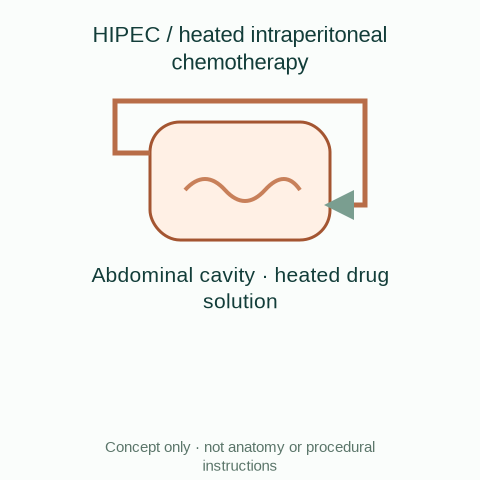
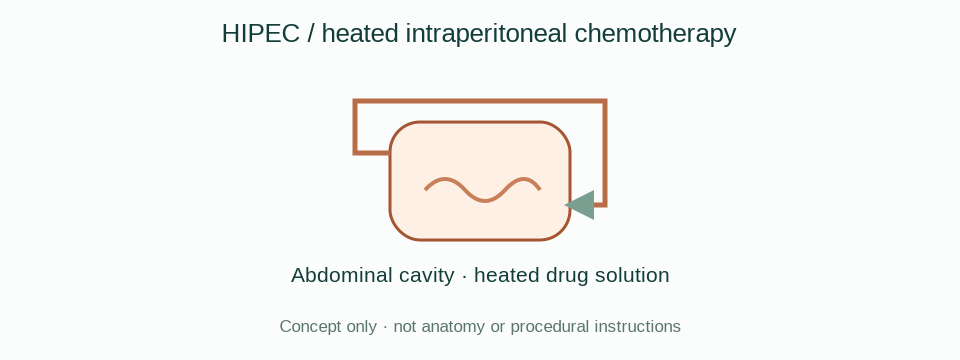
HIPEC / heated intraperitoneal chemotherapy

Abdominal cavity · heated medicines

Concept diagram: HIPEC / heated intraperitoneal chemotherapy
Read principles, assessment, and risks
Concept comparison, without rankings or recommendations.
AspectInterventional oncology / TACEHIPEC / heated intraperitoneal chemotherapy
How it worksInterventional oncology uses imaging to guide catheter or needle procedures. TACE delivers medicines and embolic material into tumour-supplying vessels in selected cases.HIPEC circulates heated anticancer-drug solution in the abdominal cavity, generally during surgery for selected patients with peritoneal disease.
What is assessedAssessment considers vascular anatomy, tumour type and extent, organ function, clotting, and other therapies. Liver reserve is especially important for hepatic treatment.Assessment considers cancer type, peritoneal extent, feasibility of tumour removal, previous care, organ health, and nutrition. Evidence differs by disease.
Risks & limitsPain, fever, organ dysfunction, bleeding, or non-target embolisation may occur. TACE, ablation, and systemic therapy are not interchangeable.HIPEC is not routine intravenous chemotherapy or a replacement for all systemic treatment. Discuss infection, bowel leakage, renal effects, and major surgical complications.

Schematics are conceptual. Technologies with different purposes are not necessarily alternatives. Open each topic for its sources and context.

Why might this case need another review?

An additional review may be relevant when tumor location and burden, imaging, pathology, organ function, prior treatment, or the care goal requires discussion by an appropriate team.

A question the hospital can assess

Does the disease pattern and patient condition need multidisciplinary review before a precision or interventional oncology option is considered?

Records for the first review

  • Recent CT, MRI, or PET and imaging reports
  • Available pathology or diagnosis summary
  • Relevant organ-function testing
  • Treatment history, medicines, and the family goal

Start with what you already have. You do not need to wait until every record is complete; the hospital may request other records or tests after reviewing the case.

What BKC helps coordinate

  • Organizing context and questions from the records you have.
  • Checking early readiness and recording what is still missing.
  • Requesting an official hospital response when review is requested and the pathway is available.

What can be reviewed before travel?

The Case can be organized to ask the hospital about information completeness, clinical questions, and whether an in-person review should be considered before travel.

Travel documents are discussed after review

Passports, visas, tickets, accommodation, and companion needs belong to travel preparation. They are separate from the first-review records and are discussed after the hospital requirements are clearer.

What remains uncertain?

BKC does not determine that TACE, ablation, stereotactic radiotherapy, or another technique suits a particular case. Options, risks, cost, and availability await formal review.

Why might China be relevant?

China may be relevant when the capability to assess is beyond the current local pathway and an appropriate participating Fosun Health hospital can review the Case.

What happens after Start My Case?

  1. The Case ID and basic context are recorded.
  2. A human coordinator checks readiness and what records may still be needed.
  3. When requested, the Case is routed for appropriate hospital review.

Start a Case with the records you already have. The first question is whether review is worthwhile, not which procedure to choose.

Frequently asked questions

Does this page determine whether I am suitable for a specific treatment?

No. This page helps prepare questions and records. Suitability, care options, and formal acceptance are determined through hospital and physician review of the Case.

What happens after I start a Case?

BKC records a Case ID, checks context and document readiness with a human coordinator, and may request review from an appropriate participating Fosun Health hospital when you ask for it.

Have reports? Start with a Case.

Start a Case with the records you already have. The first question is whether review is worthwhile, not which procedure to choose.

EXPLORE NEXT

Continue exploring from here

Choose the next public topic based on the page you are viewing.

These recommendations are editorial and public; they do not infer your condition or medical suitability.

Explore first. Prepare your questions.

Short guides, hospital photos, and videos to explore with your family.

Interventional oncology: ask about the goal