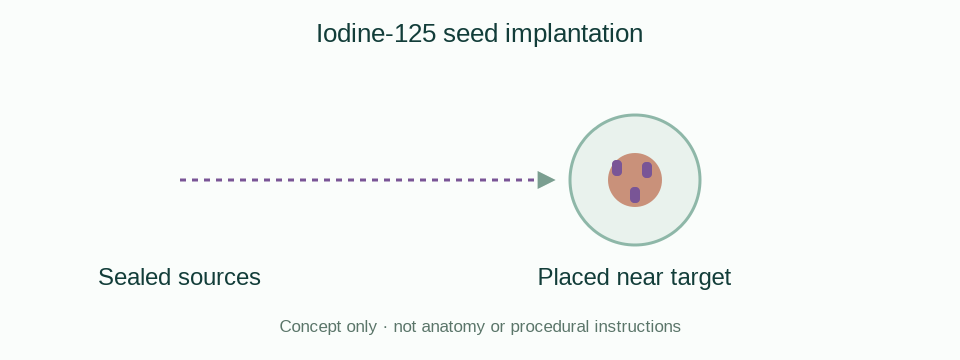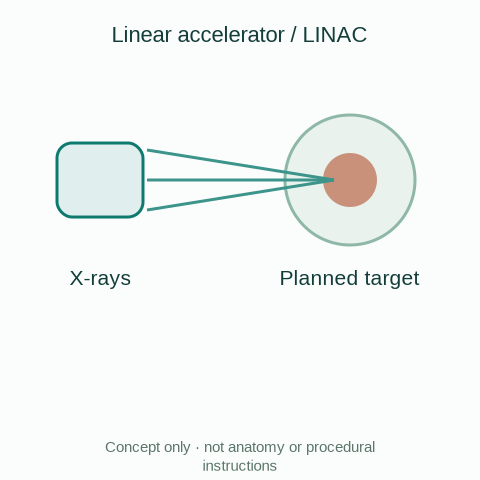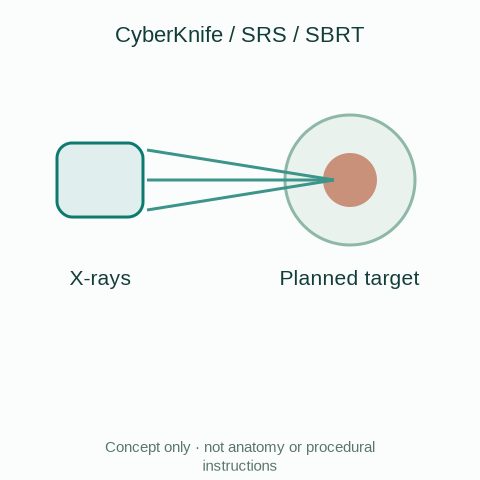
Original BKC concept illustration; not a device photograph, anatomical image, or instructions for performing a procedure.
01Principle & mechanism
CyberKnife is an image-guided robotic stereotactic radiotherapy system. SRS and SBRT describe focused radiation approaches; radiosurgery does not mean cutting surgery.
02What informs suitability
Size, location, target motion, nearby sensitive organs, and previous radiation affect planning. Large doses per fraction do not suit every tumour.
03Typical pathway
The pathway includes consultation, planning imaging, target and dose definition, delivery, and follow-up. The team determines session numbers, not the device brand.
04Risks & evidence limits
Radiation can affect healthy tissue. Side effects depend on site and dose; follow-up images and size changes require clinical interpretation.
Watch first. Understand more easily.
Original BKC explainers
24 seconds · silent text video
Radiation, ablation, surgery: what differs?
Read the video transcript
Radiation targets a planned area. CyberKnife uses X-rays. It is not surgery with a blade.
Ablation acts on a local target. RFA uses heat from radiofrequency energy. Risks and target location need assessment.
Surgery describes a procedure. Procedure, access approach, and recovery are three different questions.
Start with the care goal. Discuss options and combinations with a doctor, based on diagnosis and patient condition.
Prepared by BKC editorial, 22 October 2026. General education, not a diagnosis or personal treatment selection. A topic listing does not establish availability at a particular hospital.
Concept comparison, without rankings or recommendations.
Aspect
CyberKnife / SRS / SBRT
Linear accelerator / LINAC
How it works
CyberKnife is an image-guided robotic stereotactic radiotherapy system. SRS and SBRT describe focused radiation approaches; radiosurgery does not mean cutting surgery.
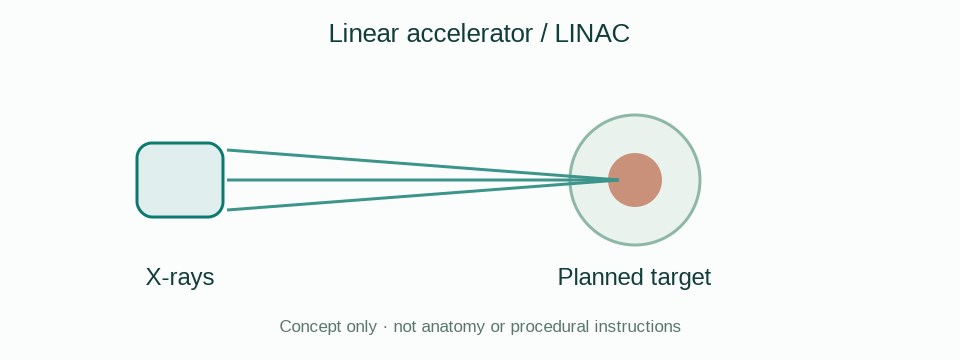
A LINAC delivers radiation from outside the body. IMRT, VMAT, and stereotactic radiation are planning or delivery techniques; actual capability depends on configuration and team.
What is assessed
Size, location, target motion, nearby sensitive organs, and previous radiation affect planning. Large doses per fraction do not suit every tumour.
Clinicians define goals, target volume, protected organs, and dose fractionation. Imaging supports positioning and treatment checks.
Risks & limits
Radiation can affect healthy tissue. Side effects depend on site and dose; follow-up images and size changes require clinical interpretation.
VitalBeam is not a single care plan or proof that every feature is installed. Compare it with CyberKnife by clinical needs, not device rankings.
Schematics are conceptual. Technologies with different purposes are not necessarily alternatives. Open each topic for its sources and context.
Read the full guide and sources
RADIOTERAPI PRESISI
CyberKnife
A radiotherapy technology that must be discussed against the records and clinical plan. Questions about CyberKnife in China start with case review.
WHAT NEEDS CONFIRMING
Ask the hospital whether this technology is available for your case and which records are needed. BKC helps prepare a review request; this page is not proof of availability.
Key facts
Laporancurrent and concise
Pencitraanwith available reports
Pertanyaanclear before review
Estimasirequested in writing per case
What this technology is
Accuray describes CyberKnife as a robotic stereotactic radiotherapy system using image guidance and motion tracking. This technical explanation helps families frame questions; the technology, device name, or source does not determine suitability, outcomes, or a care plan.
What needs confirming
Hospital confirmationDoes the hospital have this technology and accept review requests from Indonesian patients?
RecordsWhich current reports and imaging should be sent before the hospital responds?
Reviewing teamWhich team reviews the case, and what can be answered before an in-person assessment?
Cost & timingHow will hospital cost, testing, travel, and estimate validity be separated after review?
When it is usually considered
This page does not set an indication list or tumor-size threshold. A doctor must assess the diagnosis, imaging, lesion location and count, treatment history, general condition, and care goal before discussing radiotherapy options.
The journey
1Send the available diagnosis summary, reports, and imaging
2A coordinator checks context and missing records
3Request a written hospital response on review, availability, and next steps
4Compare scope, cost, and timing before discussing travel
Request an official estimate
This page lists no fixed price. Request a written estimate after the hospital reviews the case; separate hospital cost, additional tests, coordination, travel, and estimate validity.
The official estimate follows hospital evaluation and can change after the clinical plan is set.
Before asking for a price
A hospital cannot give a number from the technology name alone. These three items make the price question reviewable.
Recent imaging (CT, MRI or PET) with the radiology report.
Pathology or biopsy report, if available.
Treatment history, current medicines, and one question the hospital should answer.
Do not send medical documents over WhatsApp. Use the secure Start Case; the hospital still determines eligibility, availability and price.
This page does not prove availability. The hospital must confirm the technology, review pathway, reviewing doctor or team, and schedule based on the case information submitted.
Which records should be prepared?
Start with the diagnosis summary, pathology when available, current imaging and reports, treatment history, medicines, and the questions you want answered. The hospital may request more.
Is CyberKnife the same as surgery?
CyberKnife is the name of a stereotactic radiotherapy technology. The correct terminology, care options, risks, and plan for a case must be explained by the reviewing doctor.
How much does CyberKnife cost in China?
This page cannot responsibly publish a fixed price. Request a written estimate after review and separate medical, testing, travel, and exclusion items.
Technical source: Accuray, CyberKnife. This source describes the technology; it does not prove hospital availability, suitability, cost, or patient outcomes.
If you have emergency symptoms, contact local emergency services (in Indonesia: 119) or the nearest hospital — do not wait for a reply from BKC.
Start here
If your doctor mentions precision radiotherapy, prepare recent imaging, a diagnosis summary, and treatment history for hospital review. This page helps prepare questions; suitability and the care plan are decided by the reviewing doctor.
Verified evidence
✓Request a written estimate after the hospital reviews diagnosis, imaging, session count, admission needs, and travel plan.
A Fosun Health member hospital in the Greater Bay Area for complex-condition and family pathways.
One place to explore oncology, cardiovascular, orthopedics/spine, urology, and women’s and children’s health—with the plan confirmed by the hospital.
Medical oncology and case navigation
Precision radiation oncology
Surgical oncology
Heart and vascular care
Orthopedics, spine, and urology
A strong option when a family needs to map several specialist needs in one clear conversation, then request official confirmation of doctors, technology, and next steps.
WhatsApp opens a draft only; no message is sent or Case created. If WhatsApp is unavailable, use Start Case. For emergencies, contact local emergency services.