← Medical library

Technology & treatment

Cryoablation

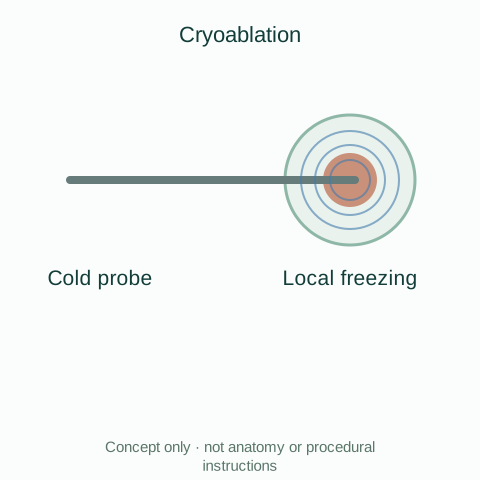
Principle diagram: Cryoablation
Original BKC concept illustration; not a device photograph, anatomical image, or instructions for performing a procedure.
Principle & mechanism

Cryoablation uses extreme cold through a probe to damage target tissue. It is a local image-guided procedure, not whole-body cooling.

What informs suitability

Location, size, lesion number, probe access, and nearby nerves or sensitive organs determine feasibility. Organ function and bleeding risk also matter.

Typical pathway

After planning and appropriate anaesthesia, probes are positioned and freeze-thaw cycles are monitored. Follow-up imaging assesses the treated area.

Risks & evidence limits

Pain, bleeding, infection, and nearby-structure injury remain possible. Not every lesion is accessible or fully treated with one ablation.

Watch first. Understand more easily.

Original BKC explainers
24 seconds · silent text video

Radiation, ablation, surgery: what differs?

Read the video transcript
  1. Radiation targets a planned area. CyberKnife uses X-rays. It is not surgery with a blade.
  2. Ablation acts on a local target. RFA uses heat from radiofrequency energy. Risks and target location need assessment.
  3. Surgery describes a procedure. Procedure, access approach, and recovery are three different questions.
  4. Start with the care goal. Discuss options and combinations with a doctor, based on diagnosis and patient condition.
Explore the topic further →

Reading sources

Prepared by BKC editorial, 22 October 2026. General education, not a diagnosis or personal treatment selection. A topic listing does not establish availability at a particular hospital.

Connect the concepts

All topics →

SEE THEM SIDE BY SIDE

Different names. Understand how they work.

Compare principles, assessment, and evidence limits. A reading tool, not a way to select your treatment.

Cryoablation

Cold · target probes

Concept diagram: Cryoablation
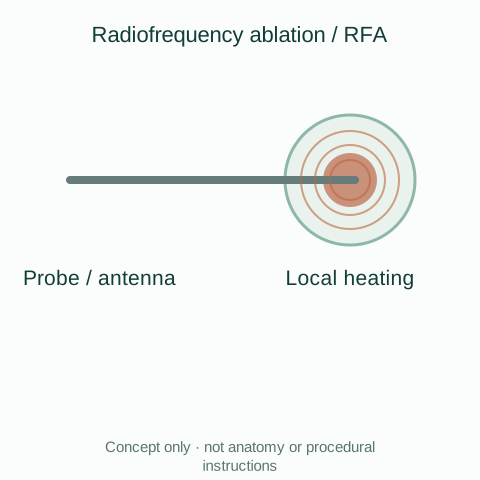
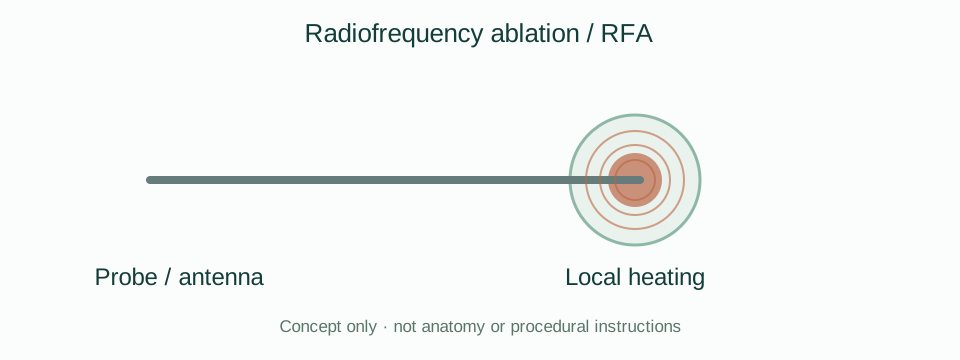
Radiofrequency ablation / RFA

Heat · radiofrequency energy

Concept diagram: Radiofrequency ablation / RFA
Read principles, assessment, and risks
Concept comparison, without rankings or recommendations.
AspectCryoablationRadiofrequency ablation / RFA
How it worksCryoablation uses extreme cold through a probe to damage target tissue. It is a local image-guided procedure, not whole-body cooling.RFA uses radiofrequency energy through an electrode to heat target tissue. It differs from radiotherapy, which uses ionising radiation.
What is assessedLocation, size, lesion number, probe access, and nearby nerves or sensitive organs determine feasibility. Organ function and bleeding risk also matter.Lesion size and position, nearby vessels, access, and organ safety determine planning. Some locations or shapes limit local treatment.
Risks & limitsPain, bleeding, infection, and nearby-structure injury remain possible. Not every lesion is accessible or fully treated with one ablation.Risks include pain, bleeding, infection, and thermal injury near the target. Local ablation does not automatically treat spread elsewhere.

Schematics are conceptual. Technologies with different purposes are not necessarily alternatives. Open each topic for its sources and context.

Understand more? Bring your questions.

Doctors assess options from the case, beyond a technology name alone.

Start My Case